I almost didn’t write this article. Not because the topic isn’t worth covering — it absolutely is. But because every time I tried to start, it came out sounding like a brochure.The kind of thing you skim and forget.
So let me try this differently. Let me just talk to you like I’m sitting across a table from you, coffee in hand, and you have just asked me: “Is studying AI in China actually worth it?”
My answer? For the right person — yes. Genuinely, yes.
Here is everything I know.
Table of Contents
How I Even Started Looking at This
A friend of mine was trying to get into an AI master’s program. Smart guy. Computer Science degree, decent research experience, solid grades. He spent months looking at programs in Germany, Canada, and the UK.
On one evening, he called me, and he became excited for the first time in months. He had found the Chinese Government Scholarship. Free tuition, accommodation, monthly stipend at Tsinghua University, which is among the top 25 universities in the world.
He got it.
That phone call is the reason I spent the next few weeks going deep on this topic. I read scholarship documents, talked to students currently enrolled in these programs, and went through every English-taught AI program I could find at China’s top universities.
What I found surprised me. And I think it will surprise you, too.
Why China Makes Sense Right Now
Before I get into the specific universities, I want to address the obvious question. Why China? Why not Europe, Australia, or Canada?
Three reasons. And I’ll keep them simple.
Money: Tuition at China’s top universities for international students runs between $3,000 and $5,000 USD per year. That’s not a typo. And the Chinese Government Scholarship — run by the China Scholarship Council, or CSC — covers even that for thousands of international students every year. You walk away with a world-class degree and little to no debt.
Research Access: Companies like Baidu, Huawei, and ByteDance don’t just recruit from these universities. They fund labs there. They co-supervise research. Some students end up working directly alongside engineers from these companies on their thesis projects. That kind of access is rare anywhere in the world.
English Programs: It is not essential for you to speak Mandarin fluently to study in China. There are so many programs being taught in the English medium. China built these programs specifically to attract international students, and they’ve invested seriously in making them work.
The Stanford AI Index Report 2024 indicates that, currently, China is producing more AI research papers than other countries in the world.
The 5 Chinese Universities for an AI Master’s Degree
1. Tsinghua University — Beijing
World Rank No. 25
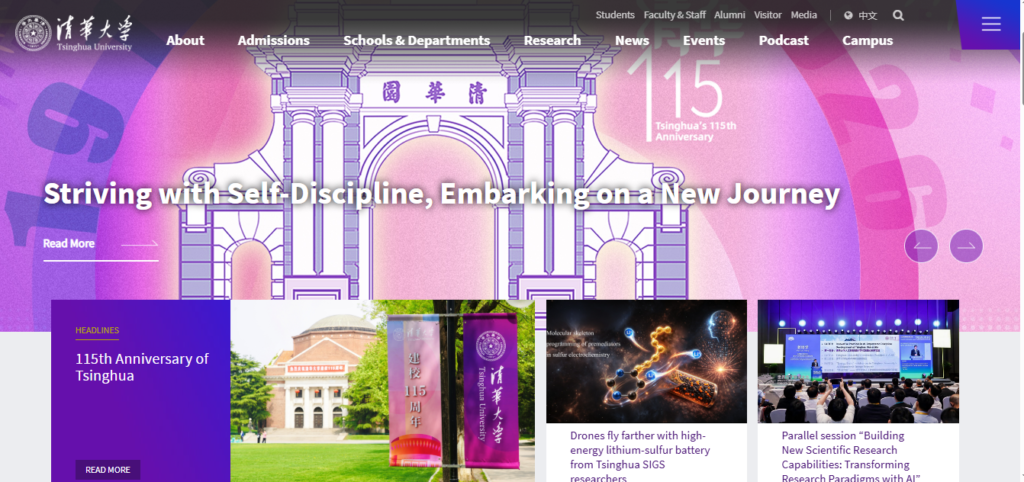
I’ll be honest — Tsinghua was the first name that came up in every single conversation I had. Students currently enrolled there, professors I reached out to, people working in AI research in Asia — they all said the same thing. If you want the best AI program in China, this is where you start.
The research coming out of Tsinghua’s School of Software and Department of Computer Science regularly appears in NeurIPS and ICML — the conferences where the world’s most important AI work gets presented. That tells you something about the level you’re operating at when you study here.
The program I’d look at first is the Master of Engineering in Artificial Intelligence. It combines theory with real system-building. You’re not just reading papers — you’re building things and understanding deeply why they work or don’t.
One thing I’d strongly recommend: Before you even submit your application, email professors at Tsinghua whose research interests you. Read their recent papers first — actually read them — and then write a short, specific email explaining the connection to your own background. Tsinghua uses an advisor-matching model. A professor agreeing to supervise you makes your application significantly stronger.
Scholarship tip: Apply through the CSC portal AND directly through Tsinghua’s admissions office. Both at the same time. Students who’ve done this tell me it genuinely improves their chances compared to only going through one channel.
2. Peking University (PKU) — Beijing
World Rank No: 17
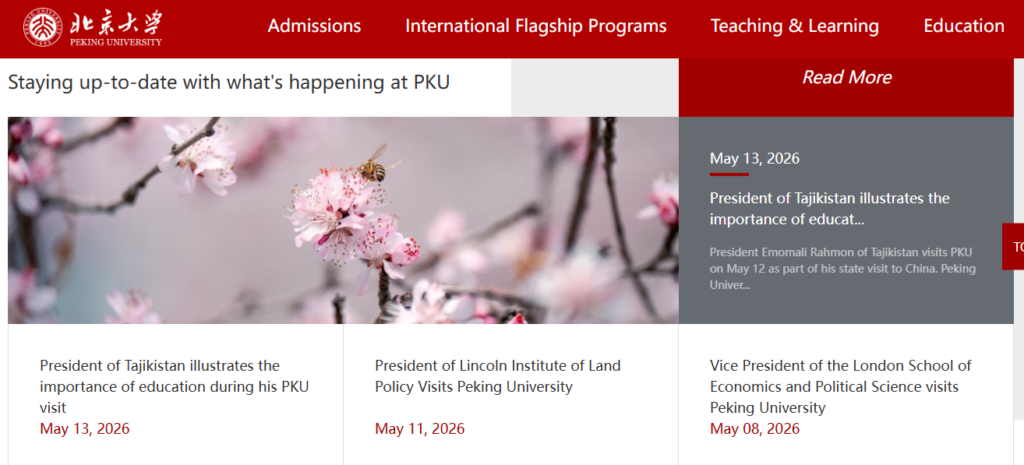
PKU and Tsinghua are a few kilometres away from Beijing. Tsinghua leans towards engineering and systems. PKU leans deeper — more theoretical, more foundational, more interested in the science behind the technology rather than just the application of it.
If you’re someone who wants to understand why machine learning works the way it does — the math, the theory, the open questions — PKU might actually fit you better than Tsinghua.
The Centre on Frontiers of Computing Studies at PKU is particularly interesting. It’s small and selective, but the work coming out of it in theoretical CS and AI is serious. It’s the kind of place where your thinking gets sharpened in ways that stay with you for your whole career.
What PKU wants to see in your application: Not a list of projects. Not a generic statement about your passion for AI. They want to see that you’ve actually read the literature, that you understand what problems are still unsolved in your area, and that you have a specific intellectual question you want to chase. Write your personal statement like that. It’s a different kind of document than most applicants submit.
3. Shanghai Jiao Tong (SJTU) University, Shanghai
World Rank No. 51
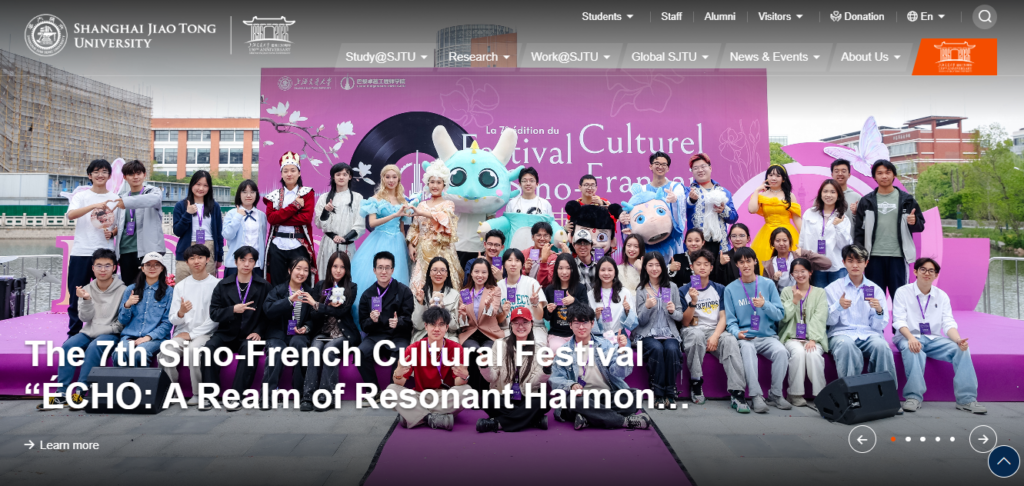
I want to tell you something about Shanghai that the university brochures won’t say directly. The city itself is part of the education.
Shanghai is China’s commercial capital. International companies, startups, finance firms, and tech giants all have serious operations there. Alibaba’s research divisions are nearby. During your program at SJTU, internship and networking opportunities exist in a way that’s genuinely different from what you’d find in a smaller city.
SJTU’s programs — particularly the MSc in Computer Science and Engineering — are built with industry outcomes in mind. The faculty has strong connections to real companies working on real problems. If you want a degree that prepares you for a career at a major tech company, not just a career in academia, SJTU is worth serious consideration.
There’s also a Joint International Master’s Program that lets you split time between SJTU and a partner university in Europe or North America. If you want international exposure across multiple environments, that structure is genuinely appealing.
4. Zhejiang (ZJU) University, Hangzhou
World Rank No. 47
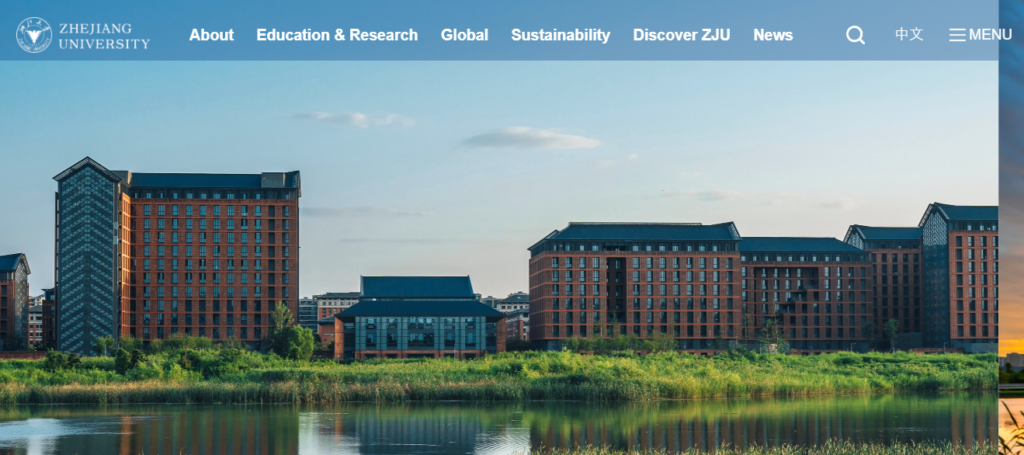
Here is complete info that most people do not know about ZJU: it is located in Hangzhou, which is a city where the Alibaba multinational company was founded. Alibaba DAMO Academy — one of the largest private AI research organisations in the world — collaborates directly with ZJU’s AI Institute. That relationship shows up in funding, in faculty experience, and in the kinds of research projects available to master’s students.
ZJU is also, frankly, more accessible for international applicants than Tsinghua or PKU. Acceptance rates are somewhat higher. The international student community is well-established. It’s a strong university in a city that’s deeply embedded in China’s tech economy.
I’d also say this: if you’re worried about competition for scholarships, ZJU is worth looking at strategically. Fewer international applicants means your profile stands out more. The ZJU scholarship has three tiers — Type A covers tuition, accommodation, and stipend. Combined with the Zhejiang Provincial Government Scholarship, strong applicants often get a very complete funding package.
5. University of Science and Technology of China (USTC) — Hefei
World Rank No. 93
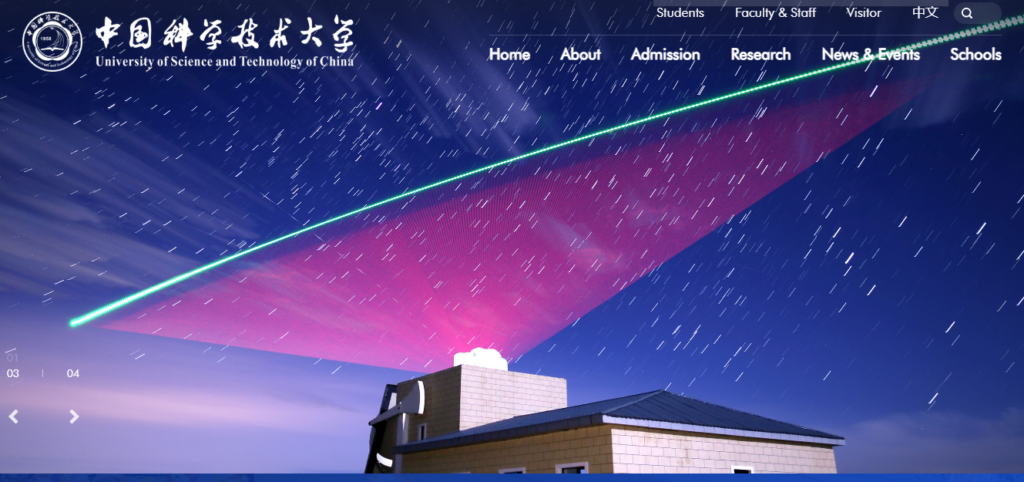
USTC is the one I didn’t expect to like as much as I do.
It was founded by the Chinese Academy of Sciences, which tells you right away what this institution is about. Research first. Always. It doesn’t have the brand name recognition of Tsinghua or the city appeal of SJTU, but in terms of pure research culture and faculty quality, it belongs on this list without any hesitation.
Hefei is a smaller city. That means your monthly stipend actually goes somewhere. Rent is cheaper. The environment on campus is quiet and focused. If you’re the kind of person who wants to put your head down and do serious research work without the distractions of a massive city around you, USTC is honestly ideal.
The work coming out of USTC at the intersection of quantum computing and AI is world-class. That same culture of deep, experimental thinking runs through all of their CS and AI programs.
And here’s the strategic point I keep coming back to: USTC receives fewer international applications than the other universities on this list. Competition for CSC scholarships here is comparatively lower. For a strong applicant who does their homework, this is a genuinely smart place to apply.
How to Actually Apply — What I’d Do If I Were You
I talked to several students who got into these programs. I asked them what made the difference. Here’s what they told me, and what I observed from reading through the process myself.
Start in September. I mean September of the year before you want to enrol. CSC deadlines fall in March or April. Everything you need to prepare — your research statement, professor outreach, notarised transcripts — takes longer than you think.
Write a research statement that names something real. “I’m passionate about deep learning” gets you nowhere. “I want to study transformer efficiency under low-resource conditions, building on my undergraduate work in model compression” gets attention. Be specific. Show you’ve already started thinking like a researcher.
Email three to five professors before you apply. Read a recent paper from each one first. Then write a short email — not a long one — explaining what specifically interested you in their work and how your background connects to it. Some won’t respond. But the ones who do? That response is worth more than a tenth of a point on your GPA.
Get your documents sorted early. Officially translated and notarised transcripts can take four to six weeks. Don’t discover this in February.
You can apply to multiple universities at the same time. And write a separate statement for each one. A copy-pasted statement shows. Admissions offices read hundreds of these.
Also Read: Best Freelancing Skills for Beginners in 2026 – 27
What Actually Living There Is Like
A few practical things I want to mention because nobody usually covers them properly.
You’ll need a VPN to access Google Scholar, GitHub, and most Western platforms. Get a reliable one sorted out before you arrive, not after.
The language barrier is real, but not as big as you might fear. Apps like Pleco handle translation well. English is used in academic settings at all five of these universities.
The workload is serious. Your supervisor will likely expect regular meetings, consistent progress, and conference submissions. That’s not something to be nervous about — it’s the reason people who come out of these programs are so well-prepared.
General FAQs
Do I actually need Mandarin to get in?
For the English-taught programs at these five universities. But learning even basic Mandarin before you go makes your daily life significantly easier. Restaurants, transport, local shops — it adds up.
How hard is it to get the CSC scholarship?
It’s competitive. But it provides the CSC with around 50,000 scholarships per year in various programs. It is mandatory to have A CGPA above 3.5, focused research goals, and strong recommendation letters to put you in a real position to get one.
Will employers outside China recognise these degrees?
Yes! All five universities are C9 League institutions — China’s equivalent of the Ivy League. Graduates from these programs go on to PhD programs at MIT, Stanford, and ETH Zurich. The degree carries weight internationally.
How long will the program take?
Most master’s programs here run two to three years. Research-focused tracks tied to a specific lab tend toward three.
Can I do an internship while studying?
Off-campus paid employment has visa restrictions. But supervised research internships through companies like Alibaba DAMO Academy, Huawei Research, and ByteDance’s AI Lab are completely permitted and very common. Many students do exactly this.
How to start test preparation?
Now. If you are willing to get admission in September this year, you should identify professors and draft your research statement today.
What I Actually Think
If it’s your commitment to study abroad in China, then it is a real commitment. The distance from home is real. The cultural adjustment is real. And yes, the geopolitical conversation around China is something worth reading about and thinking through for yourself. I’m not going to brush past that.
But here’s what I keep coming back to. The alternative — taking on $100,000+ in student debt for a program in North America or Europe — is also a real commitment. A financial one that follows you for years.
Universities like Tsinghua, PKU, SJTU, ZJU, and USTC are serious, world-class researchers in the AI field. The companies operating in these cities are building technology that the rest of the world is paying attention to. The faculty at these schools are publishing work that defines where the field is going.
My friend figured this out. He has finished his second year at Tsinghua, working on research he could not have accessed anywhere else, and he has not paid a dollar in tuition.
The opportunity is real. Whether you take it is up to you.